
How Loan Apps in India Charge High Interest: What Every Borrower Should Know
 Golden India
5 min read
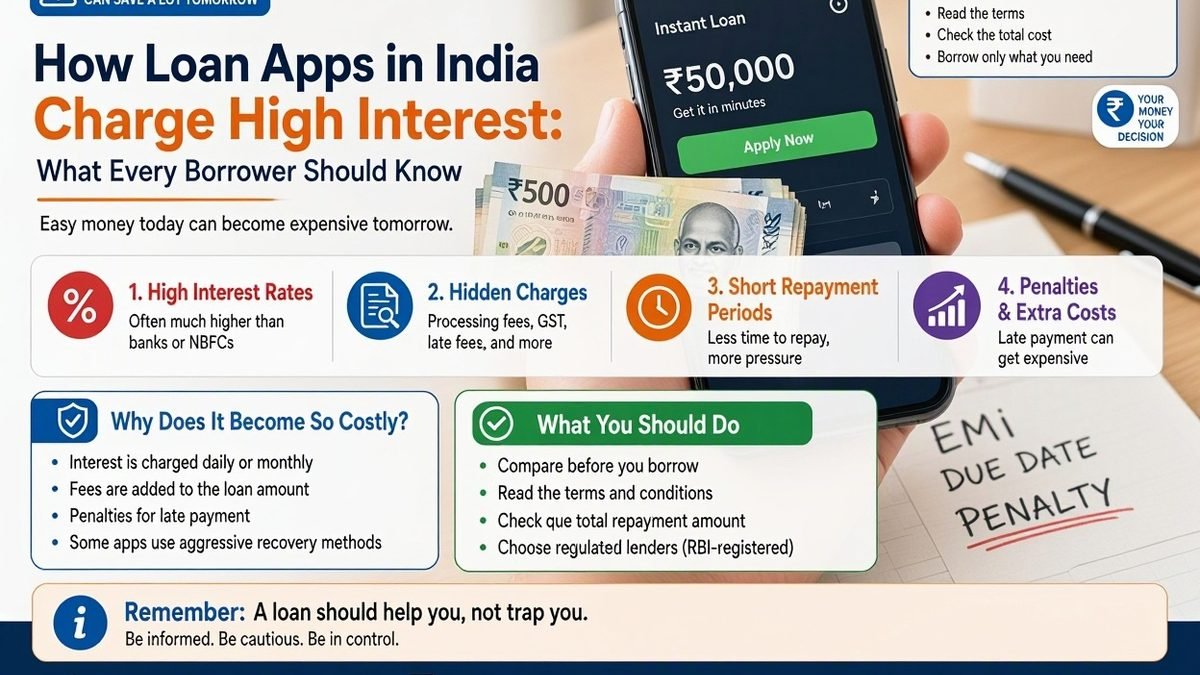
A plain-language guide for borrowers
Instant loan apps in india promise money in minutes, with no paperwork and no branch visit. For people facing a medical bill, a delayed salary or a sudden expense, that sounds like a lifeline. But many borrowers discover later that the loan cost far more than they expected. This guide explains, in simple terms, how that happens and how to protect yourself.
1. The interest rate you see is not the real cost
Most apps advertise a low-looking number, such as “interest starting at 1% per month” or “0.1% per day”. But interest is only one part of what you pay. The real cost includes several other charges, which are often mentioned in small print or only shown at the last step.
2. The hidden layers of cost
Processing fees. A fee, often 5% to 15% of the loan amount, is charged for “processing” the loan. It is usually deducted before the money reaches you.
GST on fees. Government tax of 18% is charged on the processing fee and some other charges, which increases the deduction.
Platform, convenience and documentation fees. Some apps add extra fees with different names. Each one reduces the money you receive.
Insurance or add-on products. Some borrowers find a small insurance or membership charge included without having clearly chosen it.
Late payment penalties. If you miss the due date, daily penalties and extra charges can pile up quickly, sometimes on top of regular interest.
Prepayment or foreclosure charges. Some lenders charge you for paying the loan off early.
3. You borrow less than you repay on
This is the most important trick to understand. Suppose you apply for Rs. 10,000, and the app deducts a 10% processing fee (Rs. 1,000) plus 18% GST on that fee (Rs. 180). You actually receive Rs. 8,820, but you must repay the full Rs. 10,000 plus interest.
4. Very short repayment periods make the yearly rate huge
Many apps offer loans for only 7, 15 or 30 days. A small charge for a short period looks harmless, but when it is converted to a yearly rate, it becomes enormous.
A worked example (illustrative numbers):
- Loan applied for: Rs. 10,000
- Fees and GST deducted upfront: Rs. 1,180
- Money you receive: Rs. 8,820
- Interest for 15 days: Rs. 300
- Total you repay after 15 days: Rs. 10,300
- Total cost of borrowing: Rs. 1,480 on Rs. 8,820 in just 15 days
That is about 17% in two weeks. Over a full year, this works out to a yearly cost of over 400%, compared with roughly 10% to 20% a year for a typical bank personal loan. The advertised interest looked small, but the real cost was many times higher.
5. The APR: the number that tells the truth
The Annual Percentage Rate (APR) combines interest and all fees into one yearly figure, so you can compare loans fairly. Under Reserve Bank of India (RBI) rules for digital lending, lenders must give you a Key Fact Statement (KFS) before you accept a loan. It lists the loan amount, all charges, the APR, the repayment schedule and the amount you will actually receive. Always read this before clicking “accept”. If an app does not show it clearly, treat that as a warning sign.
6. Rolling over and repeat borrowing
When borrowers cannot repay on time, some apps offer an “extension” or encourage taking a new loan to clear the old one. Each rollover can bring fresh fees, so the debt grows. Some people end up borrowing from several apps to repay others, which creates a debt trap that is hard to escape.
7. Aggressive recovery and misuse of your phone data
Some apps ask for access to your contacts, photos or messages during installation. Borrowers have reported that this data was later used to call or message their family, friends or colleagues about the loan. Under RBI rules, lenders and their agents must not harass or intimidate borrowers, should not contact people other than you to shame you, and should follow reasonable calling hours. Lenders are also restricted from accessing your phone data like contacts and files without a valid need.
8. Warning signs of a risky loan app
- It does not name the regulated lender behind the loan
- It asks for access to your contacts, gallery or files
- It does not show the total repayment amount or APR upfront
- It pressures you to decide quickly
- It asks you to pay a fee before the loan is released
- Reviews repeatedly mention harassment or hidden charges
- It cannot be verified on official RBI lists
9. How to protect yourself
- Check the lender. Confirm that the lender is a bank or an RBI-registered NBFC, and check the RBI’s list of digital lending apps on its website before borrowing.
- Read the Key Fact Statement. Look at the APR and the amount you will actually receive, not just the interest rate.
- Calculate the real cost. Subtract all fees from the loan amount and compare what you receive with what you repay.
- Deny unnecessary permissions. A loan app does not need your contact list or photo gallery.
- Borrow only what you can repay on time. Avoid using one loan app to repay another.
- Keep records. Save screenshots of the loan terms, payment receipts and any threatening messages or calls.
- Ask for a closure certificate (NOC) in writing once you have repaid the loan, and check that your credit record is updated.
- Compare alternatives. Banks, credit unions, salary advances from employers or government schemes may cost far less.
10. Where to complain if you are harassed or overcharged
- RBI complaint portal (cms.rbi.org.in) for complaints against banks and NBFCs
- National Cybercrime Reporting Portal (cybercrime.gov.in) or helpline 1930 for threats, data misuse and online fraud
- National Consumer Helpline (consumerhelpline.gov.in) for consumer complaints
- Your local police station for threats, intimidation or physical harassment
The bottom line
A loan is only “easy” if you understand what it will cost you. Before accepting any instant loan, ask three questions: Who is the lender? What is the total amount I must repay? What is the yearly cost (APR)? If you cannot get clear answers, walk away.
This article is for general information and awareness only. It is not legal or financial advice, and the figures in the example are illustrative. Rules can change, so check the RBI website for the latest guidelines.