
Swami Vivekananda Biography: Life, Teachings and Legacy
 Golden India
9 min read
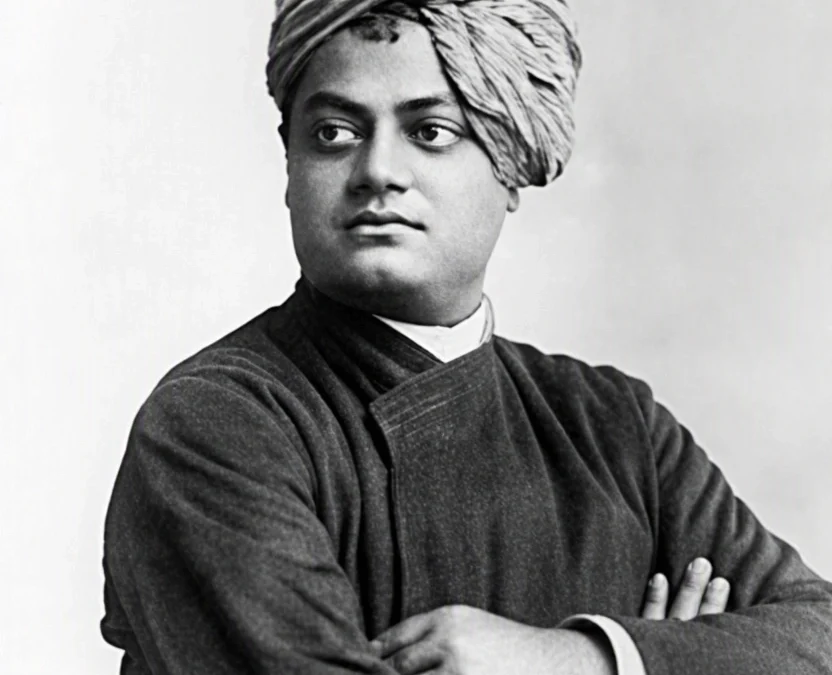
Swami Vivekananda (12 January 1863 – 4 July 1902), born Narendranath Datta, was an Indian monk, philosopher and teacher. He was the chief disciple of the mystic Ramakrishna and is best known for bringing Vedanta and yoga to the West. He also played a key role in helping Hinduism gain recognition as a major world religion. This Swami Vivekananda biography covers his early life, his spiritual search, his famous 1893 Chicago speech and the institutions he left behind.
In this article: Quick Facts · Timeline · Early Life · Meeting Ramakrishna · Ramakrishna Math · Wandering Monk · Chicago 1893 · Lecture Tours · Return to India · Final Years · Teachings · Legacy · FAQs
Table of Contents
Swami Vivekananda Quick Facts
- Full name: Narendranath Datta (Naren)
- Born: 12 January 1863, Calcutta (on Makar Sankranti)
- Died: 4 July 1902, Belur Math, aged 39
- Guru: Ramakrishna Paramahamsa
- Known for: The 1893 address at the Parliament of the World’s Religions
- Founded: Ramakrishna Math and Ramakrishna Mission
- Birthday observed as: National Youth Day (12 January)
Swami Vivekananda Timeline at a Glance
| Year | Event |
|---|---|
| 1863 | Born in Calcutta |
| 1881 | Meets Ramakrishna |
| 1884 | Father dies; completes Bachelor of Arts |
| 1886 | Ramakrishna dies; Narendra and seven brother disciples take monastic vows |
| 1888 | Begins life as a wandering monk |
| 1893 | Delivers the Chicago speech |
| 1894 | Founds the Vedanta Society of New York |
| 1896 | Publishes Raja Yoga |
| 1897 | Returns to India; founds the Ramakrishna Mission |
| 1899–1900 | Second visit to the West |
| 1902 | Dies at Belur Math |
Early Life and Education of Swami Vivekananda
Birth and Family Background
Narendranath was born into an esteemed Bengali Kayastha family at 3 Gourmohan Mukherjee Street, Calcutta, then the capital of British India. He was one of nine children. His father, Vishwanath Datta, was an attorney at the Calcutta High Court with a rational and progressive outlook. His mother, Bhubaneswari Devi, was deeply religious. His grandfather, Durgacharan Datta, was a Sanskrit and Persian scholar who left home to become a monk at 25.
As a child, Narendra was lively and hard to manage, yet strongly drawn to spirituality. He meditated in front of pictures of Shiva, Rama, Sita and Hanuman, and he was fascinated by wandering ascetics. His mother once joked that she had prayed to Shiva for a son and received one of his playful attendants.
Schooling and Studies
In 1871, Narendra joined the Metropolitan Institution, founded by Ishwar Chandra Vidyasagar. When the family returned to Calcutta in 1879, he was the only student to earn first-division marks in the Presidency College entrance exam. He later studied Western logic, philosophy and history at the General Assembly’s Institution (now the Scottish Church College) and earned his Bachelor of Arts in 1884.
He was a keen reader. He studied Hume, Kant, Hegel, Schopenhauer, Mill, Darwin and Spencer, along with the Vedas, Upanishads, Bhagavad Gita and Puranas. He also trained in Indian classical music and stayed active in sports. His principal, William Hastie, remarked that he had never met a young man of such talent, even among students at German universities.
Early Spiritual Influences
As a young man, Narendra was drawn to the Brahmo Samaj, which rejected idol worship, polytheism and caste. Philosophy alone did not satisfy him, though. He kept asking respected people whether they had actually seen God. None of their answers convinced him until he met Ramakrishna.
Meeting Ramakrishna and Becoming His Disciple
The two most likely met in November 1881, when Ramakrishna was invited to speak at a devotee’s home and heard Narendra sing. He asked the young man to visit Dakshineswar. A remark by Professor Hastie about the word “trance” also encouraged students to visit the mystic.
At first, Narendra was skeptical. He doubted Ramakrishna’s visions, disagreed with the worship of Kali and made fun of the Advaita idea of oneness with the absolute. Ramakrishna stayed calm and advised him to look at the truth from every angle.
In 1884, Narendra’s father died, leaving the family in debt. He struggled to find work and asked Ramakrishna to pray to Kali for the family’s welfare. Ramakrishna told him to go and ask the goddess himself. Narendra went to the temple three times, and each time he asked for knowledge and devotion instead of money. From then on, he accepted Ramakrishna as his guru.
In 1885, Ramakrishna fell ill with throat cancer. Narendra and the other disciples nursed him at Cossipore, where Narendra experienced nirvikalpa samadhi. Ramakrishna gave the young men ochre robes, taught them that serving people is the highest form of worship, and named Narendra their leader. Ramakrishna died on 16 August 1886.
Founding the First Ramakrishna Math
After Ramakrishna’s death, funds ran out and many householder disciples drifted away. Narendra rented a run-down house at Baranagar and survived on holy begging (madhukari). This became the first Ramakrishna Math. The monks woke at 3 a.m. to chant and meditate. On Christmas Eve 1886, Narendra and his brother disciples took formal monastic vows at Antpur.
Years as a Wandering Monk (1888–1893)
In 1888, Narendra became a parivrajaka, a wandering monk with no fixed home. He carried only a water pot, a staff, the Bhagavad Gita and The Imitation of Christ. For five years he travelled across India, mostly on foot and by train, living on alms and staying with scholars, rajas, officials, Muslims, Christians and low-caste workers.
What he saw of India’s poverty moved him to resolve to uplift the nation. His patron, Raja Ajit Singh of Khetri, suggested the name Vivekananda, from the Sanskrit viveka (discernment) and ananda (bliss). He sailed from Bombay on 31 May 1893.
Swami Vivekananda’s 1893 Chicago Speech
Reaching the Parliament of the World’s Religions
After travelling through Japan, China and Canada, Vivekananda reached Chicago on 30 July 1893. There he learned that only delegates with credentials from a recognised organisation could attend. Harvard professor John Henry Wright, one of his supporters, is said to have remarked that asking for his credentials was like asking the sun for its right to shine. With the backing of Protap Chandra Mozoomdar of the Brahmo Samaj, Vivekananda was admitted.
The Famous “Sisters and Brothers of America” Address
The Parliament opened on 11 September 1893 at the Art Institute of Chicago. Vivekananda bowed to Saraswati and began with the words “Sisters and brothers of America.” The audience of about 7,000 gave him a standing ovation that lasted two minutes. He spoke about religious tolerance and universal acceptance, citing verses from the Shiva Mahimna Stotram and the Bhagavad Gita.
The press was captivated. American newspapers called him the greatest figure at the Parliament, its president John Henry Barrows praised his influence over audiences, and William James of Harvard called him a wonder of oratory.
Lecture Tours in the United States and Europe
After Chicago, Vivekananda lectured in Chicago, Detroit, Boston and New York. He did not try to convert anyone. He wanted people to improve within their own faith. In 1894, he founded the Vedanta Society of New York. When his health suffered, he moved to free private classes on Vedanta and yoga, including sessions with a small group of disciples at Thousand Island Park in 1895. He declined professorships at Harvard and Columbia because they conflicted with his monastic life.
In England, he befriended Margaret Noble (later Sister Nivedita) and the Oxford scholar Max Müller. In Germany, he met Paul Deussen. His 1896 book Raja Yoga, an interpretation of Patanjali’s Yoga Sutras, was an instant success and is widely seen as a starting point of modern yoga in the West.
His admirers included Josephine MacLeod, William James, Nikola Tesla, Lord Kelvin and Sarah Bernhardt. He initiated Western disciples such as Swami Abhayananda and Swami Kripananda, and was gifted land in California where the Shanti Ashrama retreat was established.
Return to India (1897–1899)
Vivekananda arrived in Colombo on 15 January 1897 to a hero’s welcome. Crowds are said to have stopped trains just to hear him speak. In the West he had stressed India’s spiritual richness. At home he spoke about poverty, the caste system, science, industry and freedom from colonial rule. These talks were later published as Lectures from Colombo to Almora.
On 1 May 1897, he founded the Ramakrishna Mission in Calcutta, devoted to social service, education and relief work and based on the ideal of karma yoga. The Math handles religious work, and both are headquartered at Belur Math. He also founded the Advaita Ashrama at Mayavati and a monastery in Madras, and launched the journals Prabuddha Bharata and Udbodhan. That same year, famine relief began in Murshidabad under Swami Akhandananda.
He also inspired the industrialist Jamsetji Tata to plan a research institute, though he declined the offer to lead it.
Final Years and Death of Swami Vivekananda (1899–1902)
In June 1899, despite poor health, Vivekananda travelled west again with Sister Nivedita and Swami Turiyananda. He set up Vedanta centres in San Francisco, attended the 1900 Congress of the History of Religions in Paris and toured Europe before returning to Calcutta on 9 December 1900. He then settled at Belur Math, organising the Mission’s work while struggling with asthma, diabetes and insomnia.
On 4 July 1902, he meditated for three hours, taught Sanskrit grammar and yoga philosophy, and spoke of starting a Vedic college. That evening he retired to his room and died in meditation at 9:20 p.m., aged 39. Doctors suggested a burst blood vessel in the brain, while his followers regard it as mahasamadhi. He had predicted he would not live to see forty. He was cremated on the banks of the Ganga at Belur, opposite the spot where Ramakrishna had been cremated sixteen years earlier.
Key Teachings of Swami Vivekananda
- Service is worship: Serving people is the truest way to serve God, a lesson he took from Ramakrishna.
- Universal acceptance: All religious paths lead to the same goal.
- Strength and self-belief: He urged young people to be fearless and confident. His call to “arise, awake” is among his most quoted.
- The four yogas: Karma, Bhakti, Jnana and Raja yoga offer different routes to realising the divine within.
- Education and social upliftment: He believed India’s progress depended on educating and empowering the poor.
Swami Vivekananda’s Legacy and Influence
Vivekananda is regarded as one of the greatest thinkers of modern India. His legacy includes:
- Vedanta around the world: The Vedanta Societies of New York and San Francisco became the model for centres worldwide.
- Modern yoga: Raja Yoga shaped how the West viewed yoga.
- Social service: The Ramakrishna Mission continues to provide education, healthcare and disaster relief.
- Interfaith harmony: His message of tolerance is still widely quoted.
- Indian nationalism: His call for strength and pride inspired leaders of the freedom movement.
- National Youth Day: India celebrates his birthday on 12 January as National Youth Day.
Frequently Asked Questions About Swami Vivekananda
When and where was Swami Vivekananda born?
He was born on 12 January 1863 in Calcutta (now Kolkata), India.
What was Swami Vivekananda’s real name?
His real name was Narendranath Datta. He took the name Vivekananda in the early 1890s.
Who was Swami Vivekananda’s guru?
His guru was Ramakrishna Paramahamsa of Dakshineswar.
Why is Swami Vivekananda’s Chicago speech famous?
He opened with “Sisters and brothers of America” and received a two-minute standing ovation. His message of tolerance made him the star of the Parliament.
What organisations did Swami Vivekananda start?
He started the Ramakrishna Math, the Ramakrishna Mission and the Vedanta Societies of New York and San Francisco.
How did Swami Vivekananda die?
He died on 4 July 1902 at Belur Math, aged 39, while meditating.
Why is 12 January celebrated as National Youth Day?
India marks his birthday as National Youth Day to honour his ideals of strength, service and self-belief.